
About the Author

Most fuel buyers negotiate price first. The ones who don’t get burned negotiate procedure first.
A buyer in Karachi spent three months on an EN590 negotiation that should have taken three weeks.
Not because the price was complicated. Not because the cargo didn’t exist. The deal dragged on because the seller kept changing the procedure. First it was FOB Rotterdam. Then TTO in Fujairah because “the price is better there.” Then CIF Karachi “for simplicity.” Then something about doing POP first and deciding later.
The buyer forwarded the correspondence to us and asked which procedure was correct.
The real answer: none of them. A seller who cycles through four procedures in a single negotiation either doesn’t have a product or doesn’t want you to understand what you’re agreeing to. But the deeper problem was that the buyer couldn’t evaluate any of those offers in the first place. He didn’t understand what the acronyms meant, and his bank wasn’t going to approve a deal he couldn’t explain.
We’ve had versions of this conversation more times than we can count. So here’s the guide we’d hand to every new buyer before they touch a first offer.
Why Procedure Matters More Than Price
Most fuel trading courses spend all their time on Incoterms — FOB, CIF, CFR, EXW — as if those four letters tell you everything you need to know. They don’t. Not in bulk refined products.
The Incoterm is only half the story. The other half is the transaction model: is this cargo already loaded on a ship, sitting in a storage tank, or being pumped direct from terminal storage to your vessel? The combination of Incoterm plus transaction model plus document sequence is what actually governs:
- Who holds legal title, and exactly when it transfers
- What document you need before the payment trigger fires
- Where the physical inspection happens — loading port, on-vessel, or discharge
- Who absorbs the loss if something goes wrong in transit
Get those four things wrong and you’ve either paid for a cargo that never loads or taken delivery of product that legally isn’t yours yet. Neither outcome is recoverable quickly.
The Four Procedures You’ll Actually See in 2026
FOB — Free On Board
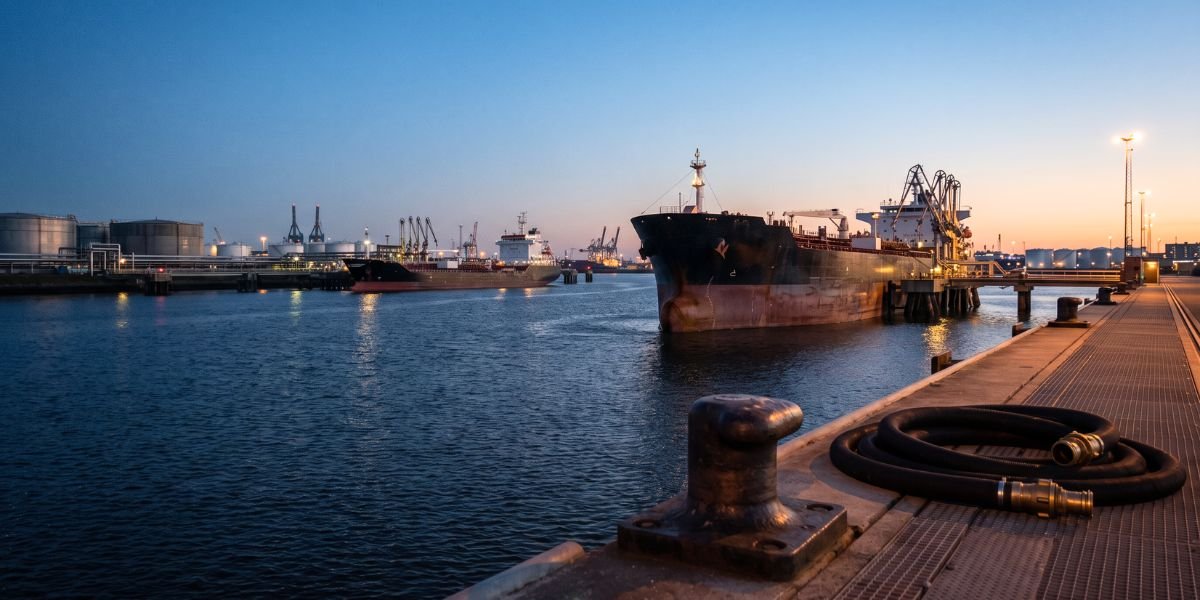
The moment the product crosses the ship’s rail at the loading arm, ownership shifts from seller to buyer. From that point, the buyer carries the risk.
You’ll see FOB offered out of Rotterdam, Houston, Fujairah, Sikka, and Singapore — the hubs where charter tonnage is easy to find and inspection firms like SGS, Saybolt, and Intertek maintain standing operations.
FOB suits buyers who either own their vessel, have an ongoing freight relationship, or are working with a freight forwarder who can nominate tonnage quickly. If you don’t have a vessel ready, FOB becomes a scramble.
Standard Document Sequence
- Buyer issues ICPO (Irrevocable Corporate Purchase Order) with full banking details
- Seller issues SCO or FCO (Soft or Full Corporate Offer)
- Both sign NCNDA and IMFPA if intermediaries are involved
- Seller issues SPA (Sales and Purchase Agreement)
- Buyer issues MT799 pre-advice from their bank
- Seller provides POP package: storage certificate, SGS Q&Q under 48 hours old, certificate of origin
- Buyer issues MT700 DLC or MT760 SBLC
- Seller nominates the loading window; buyer nominates the vessel
- SGS or Saybolt conducts loading inspection
- Bill of Lading issued
- Buyer pays via MT103 against shipping documents
⚠ Where things go sideways: Fabricated POP documents, disputes over vessel specifications, and demurrage arguments at the loading berth. Defense: a named, verifiable terminal and your own surveyor physically present at loading.
CIF — Cost, Insurance, Freight
The seller arranges and pays for both ocean freight and marine insurance to the named discharge port. What most new buyers miss — and this genuinely catches people out — is that title still transfers at the loading port, not at discharge. The seller is handling logistics on your behalf, but you own the cargo the moment it leaves the loading arm.
CIF is most common on Asia-to-Africa and Middle East-to-Asia routes, and wherever the buyer wants a single delivered price without managing freight relationships.
Document sequence follows FOB through step 7, then:
- Seller charters the vessel and arranges marine insurance
- Loading and Bill of Lading at load port
- Vessel sails to discharge
- Buyer pays MT103 against full shipping document set: commercial invoice, B/L, insurance certificate, COO, SGS report, weight certificate
⚠ Where things go sideways: Ghost tonnage, fabricated insurance certificates, cargo that loads on-spec but arrives off-spec. Defense: verify the nominated vessel against live AIS data (MarineTraffic / VesselFinder) before releasing any payment. Always contract a discharge-port surveyor.
TTO — Tank Take Over
The buyer takes legal ownership of the seller’s storage tank at a named terminal. Whatever product sits inside that tank becomes the buyer’s from the moment the tank extension registers in the buyer’s name. The buyer then arranges their own loading — or holds the tank and resells the allocation to a downstream buyer.
TTO appears frequently in Rotterdam, Houston, and Fujairah on spot deals where product is already in terminal storage and the seller wants to move a defined tank lot quickly.
Standard Document Sequence
- Buyer issues ICPO with banking details
- Seller provides fresh POP package: TSR (Tank Storage Receipt), SGS Q&Q under 48 hours, Certificate of Origin, Injection Report
- Seller issues ATSC (Authorization to Sell and Collect) in buyer’s name
- Seller extends the tank for 3 days in buyer’s name with new TSR and terminal access code
- Buyer conducts independent dip test via SGS or Saybolt-Corelab within the 48-hour window
- On a positive dip test: buyer pays 100% via MT103
- Seller issues Change of Ownership Certificate and Product Allocation Certificate
- Buyer lifts or holds
⚠ Where things go sideways: TTO is the procedure scammers reach for most often. If you’re being asked to wire a “reservation fee” anywhere between $200,000 and $700,000 BEFORE any dip test, walk. Real TTO: product confirmed first, payment after. Every time.
TTV — Tank to Vessel
The seller pumps product directly from their terminal tank into the buyer’s nominated vessel at the same port. No tank ownership changes hands — the vessel arrives, connects, loads, and sails.
TTV is cleanest in Rotterdam and Houston. It suits buyers who have already chartered tonnage and want to skip the tank-extension overhead of a full TTO.
Document Sequence
- ICPO → POP → SPA (same as FOB through step 6)
- Buyer issues CPA (Cargo Pickup Authorization) with full vessel particulars: Q88, vessel details, captain ID, RTRF
- Seller contacts vessel captain and commences injection
- SGS conducts loading inspection
- Buyer pays MT103 for actual injected quantity per invoice
- B/L issued
⚠ Where things go sideways: Backdated injection reports and sellers who insert an “extension payment” before inspection. TTV logic is simple: vessel arrives, loads, pays for what was loaded. Any extra payment trigger is a red flag.
How to Pick the Right Procedure for Your Deal
The decision isn’t complicated once you know your position.
You have a chartered vessel at a major hub: Use FOB or TTV. Title transfers at loading, your vessel takes the cargo, your surveyor is there. Cleanest procedures operationally.
You want a delivered price and have no freight infrastructure: Use CIF. Verify the vessel against AIS data yourself before releasing payment, and have your own discharge-port surveyor.
You’re buying spot product in a named tank and want to resell before lifting: Use TTO. But only with a 3-day tank extension in your name, fresh SGS dip test in your name, and payment after the dip test — never before.
The seller says “we can do any procedure, just send the reservation fee first”: Stop. Payment triggers follow document delivery, not the other way around. That’s not a procedure — that’s a theft.
Terms That Show Up in Offers But Don’t Describe Real Procedures
A few phrases circulate in fuel trading groups that don’t correspond to anything in actual market practice. If you see them in an offer, they’re telling you something about the seller.
“Refinery direct lifting.” Major refineries — Saudi Aramco, Reliance, Shell, BP — don’t sell spot volumes directly to small buyers without long-term offtake agreements. This is the single most repeated fraud line in 2026.
“In-tank product with allocation number, payment first.” Allocation numbers are printable from any laptop. Terminal storage is physical and verifiable. If the seller won’t give you both the terminal name and operator, there’s no product.
“Special procedure for friendly countries.” There is no such thing. The international refined-products market runs on standard procedures. Every serious buyer, bank, and inspection firm works from the same document framework.
“D6 virgin fuel oil from the US.” D6 is an EPA renewable fuel classification, not a fuel grade. It isn’t traded on bulk commodity markets.
The Document Glossary Your Team Should Keep Bookmarked

Frequently Asked Questions
Is TTO safer than CIF?
They’re not comparable on a safety axis — they solve different problems. TTO is for buyers who want physical control of a tank lot before they lift. CIF is for buyers who want a delivered price without managing freight. Safety in both procedures comes down to the same thing: a verifiable terminal, genuine POP documents, and an independent inspector you hired yourself.
Why do sellers keep asking for a reservation fee?
In a legitimate TTO, the 3-day tank extension is paid by the buyer — but only after a positive dip test. A “reservation fee” demanded before any inspection is a consistent scam pattern. We’ve tracked cases where buyers lost between $200,000 and $700,000 this way. If the fee comes before the dip test, it’s not part of the procedure. It’s the scam.
Can I do FOB at any port?
You can write FOB into a contract for any port, but the practical FOB hubs for bulk refined products are Rotterdam, Houston, Fujairah, Sikka, Yanbu, and Singapore. Smaller ports are possible but inspection logistics thin out quickly and your freight options narrow.
What’s the difference between an ATSC and an SPA?
The SPA is the contract between buyer and seller. The ATSC is a separate authorization document — most commonly used in TTO — that lets the buyer act on the seller’s behalf to lift and resell product from the seller’s tank. You need both in a proper TTO, and they serve distinct legal purposes.
Does my procedure choice affect financing?
Yes, significantly. FOB and CIF with a full shipping document set work cleanly with DLC (MT700) and SBLC (MT760). TTO and TTV typically settle via MT103 because the payment trigger is in-tank rather than in-transit. Some banks won’t finance TTO at all. Have that conversation with your bank before you sign the SPA, not after.
The Bottom Line
The procedure is the architecture of the deal. It defines who owns what and when. It sets the payment trigger. It assigns the loss if something goes wrong between loading and delivery.
If you can’t sketch your own deal sequence on a piece of paper — which document comes first, what happens after each one, where the money moves — you’re not ready to transfer funds. And if your seller can’t walk you through it clearly, you’ve already got your answer about them.
Settle the procedure before you touch the price. That order matters more than most buyers realize until it’s too late.
Need a deal structured the right way?
Petrolodex sources EN590, ULSD, and Jet A1 with verified terminal storage, independent SGS inspection, and procedure transparency from offer to lift.
Email info@petrolodex.com with your destination, volume, and preferred procedure — we’ll respond with a full document sequence within 48 hours.